


I recently researched and reported a story that uncovered where exactly Division 1 men's lacrosse programs in New England recruited their players. The results were intriguing, offering a glimpse into the public, prep and private representation among the top programs in the area.
It's a fitting time to dive into this data. As October inches closer, the recruiting window for players in the class of 2028 is only intensifying. And as these prospects make their decisions, players behind them eye an even bigger choice: Where should I play high school lacrosse?
That answer will be different for everyone. But a look at the data can provide helpful context for the trends taking place at the Division 1 level in New England. My findings from the men's results got me thinking: How might this data compare to local women's colleges?
So I found out by conducting the same study on the women's side. And these numbers are even more surprising.
Let's dive in.
As a reminder, the data analyzed for both of these studies focused on 2026 rosters. This is the most recent data from this past college lacrosse season. It is also the most accessible, since some teams haven't released a 2027 roster yet.
Before we get into the numbers, there were a few differences in the scope of this study compared to the men's breakdown. For starters, there are more women's programs at the Division 1 level in this region, with 20 to 15 for the men. Boston College, Central Connecticut State, Stonehill, UConn, the University of New Hampshire and the University of Rhode Island are all schools that field women's programs but not men's. And Providence has a men's team but not a women's. So the general landscape this time around is different.
However, despite more programs, there are actually fewer players in the study. I included 729 eligible players across 15 rosters in the men's data dive. This time, only 686 players represent the 20 teams in New England. That is because under the new NCAA roster rules, men's teams are capped at 48, while the women's limit is 38. But individual programs have internal limits, and many of the New England rosters actually carried fewer than 38. The average roster size across all 20 teams is 34.8 players.
I grouped players into three categories: public, prep and private. Each roster lists a player's high school team, and I only counted the school from which a player graduated. The rationale behind separating prep from private is that the governing body of a conference that a private school competes in might also include public high schools. For example, BC High is a member of the Massachusetts Interscholastic Athletic Association (MIAA), playing alongside public schools like Lincoln-Sudbury, Billerica and Longmeadow. On the flip side, the New England Preparatory School Athletic Council (NEPSAC) is home to prep institutions like Brunswick, St. Sebastian's and Thayer Academy.
Here are the numbers:
Where New England Div. 1 women's programs found their players in 2026
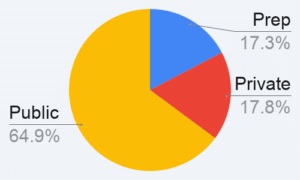
That's right, 445 of the 686 players (64.9 percent) at Division 1 colleges in New England hail from a public high school. This is vastly more than what we uncovered on the men's side, where 42.9 percent of players were recruited from a public school. What is interesting, however, is that the prep (17.3 percent) and private (17.8 percent) allocations are nearly identical. This was true in the men's study, too, with 28.7 percent prep and 28.4 percent private.
There's a lot to unpack here. First, I want to acknowledge that the geography of this study likely plays a role in the data. For instance, if I expanded this to a national stage, I would anticipate seeing more prep school representation. I made this point in the men's study, too. Some of the best players from prep commit to schools around the country all the time. Sacred Heart Greenwich star Peyla Carcaterra (Ridgefield, Conn.), for instance, recently announced her commitment to the University of Florida. Another Sacred Heart star, Ella Bacallao, committed to Michigan.
Even when removing the six colleges without a men's team, 309 of the 490 (63 percent) players in that sample come from a public school, which aligns with the overall percentage. And that is more consistent with the number of public school players on men's teams (313) in 2026. So the numbers from a similar sample size are closer, but there is still a much higher concentration of public school players on the women's side of the landscape.
READ MORE: Private vs public: Where do New England Div. 1 colleges recruit their players?
A better way to frame this might be to compare the public and prep school representation that are actually from New England. Here are the top states that produced public school talent to Division 1 colleges in this region:
Which 10 states produced the most public school players to New England Div. 1 women's colleges
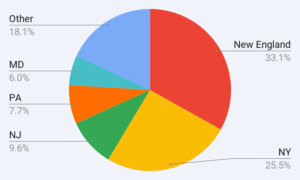
There are a lot of public high school players on Division 1 rosters in New England. But how many of them are actually from the region? Only 147 players, or 33 percent. That's because New York accounts for 148 players alone, which is another notable trend from the men's study. The majority of players competing at the Division 1 level in New England aren't actually from New England. Prep, public and private aside, here is where players were from on last year's rosters:
Where players on Division 1 women's college rosters in New England were from in 2026
A player doesn't have to be from the area to compete in the NEPSAC. But all of the schools are located in New England, narrowing our understanding of the prep or public high schools that are represented at the Division 1 level. Here is that data:
Which 8 states are home to the most prep schools players from Div. 1 women's college rosters
Between Massachusetts (32), Connecticut (17) and New Hampshire (14), the NEPSAC accounts for 63 of the 119 prep school players (53 percent) from New England Division 1 colleges last season. So if you are a player from New England deciding between a public high school or attending a prep school, looking at the data this way shows that Division 1 college programs recruited 33 percent of their public school players from the region, while nabbing 53 percent of their prep school players from institutions in the area. That's the point: While the data as a whole reflects an overwhelming amount of public school players, a lot of it isn't relevant to players in New England, a region that has more prep offerings than anywhere else. That's why the majority of private schools in this study are located outside of New England (76.2 percent), as they essentially fill the void of prep schools in New England. They are just governed by their state's athletic association.
READ MORE: Boys recruiting: Top 13 uncommitted ‘28s still on the board
There are a lot more conclusions that can be drawn when looking at the breakdown at each individual college:
This is where another key difference lies in comparison to the men's study. When analyzing the four Ivy League schools in the region --- Brown, Dartmouth, Harvard and Yale --- the men's data revealed that 45.2 percent of their players went to prep school. In this study, that number is only 32.6 percent, or 44 of 135 players. This is a jarring takeaway: 65 of the 135 players (48.1 percent) on a New England-based Ivy League team went to a public school. However, Dartmouth (15), Harvard (14) and Brown (11) are in the top four schools that recruited the most prep players. Boston College (12) recruited the third-most.
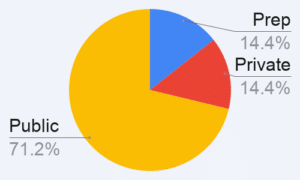
Conversely, there are groups of schools that almost solely recruit from public schools. New England schools in the America East --- Bryant, Vermont, UMass Lowell and New Hampshire --- recruited 104 of their 146 players (71.2 percent) from public high schools. Only 14.4 percent of players on those rosters came from prep.
Where New England America East women's programs found their players in 2026
A similar trend is seen in the Metro Atlantic Athletic Conference (MAAC), which includes Fairfield, Merrimack, Quinnipiac and Sacred Heart, where 96 of the 137 players (70 percent) are from public schools.
Final takeaways
I came into both of these studies assuming the majority of players competing at the Division 1 level in New England were from prep schools. Both studies, especially this one, proved me wrong. But as I mentioned, there are many caveats to that sentiment, especially when contextualizing that other areas of the country don't have prep leagues as big as the NEPSAC. It explains why areas that aren't set up with a prep model produce more public and private players.
Nonetheless, the biggest takeaway is that you can attend a public high school in New England and play at the Division 1 level. That isn't a groundbreaking statement. We see players from public schools commit to high-end programs all the time. But as the data shows, it can be done at a much higher volume than what is often perceived.
But I think an even larger looming question is similar to one I posed in the first study: How can the region produce more homegrown talent to play college lacrosse in New England? The area certainly isn't a traditional hotbed for lacrosse talent compared to states like New York or Maryland. But as club programs continue to grow --- and public school leagues like the FCIAC in Connecticut continue to thrive --- I would only anticipate seeing these numbers rise throughout the next decade.