
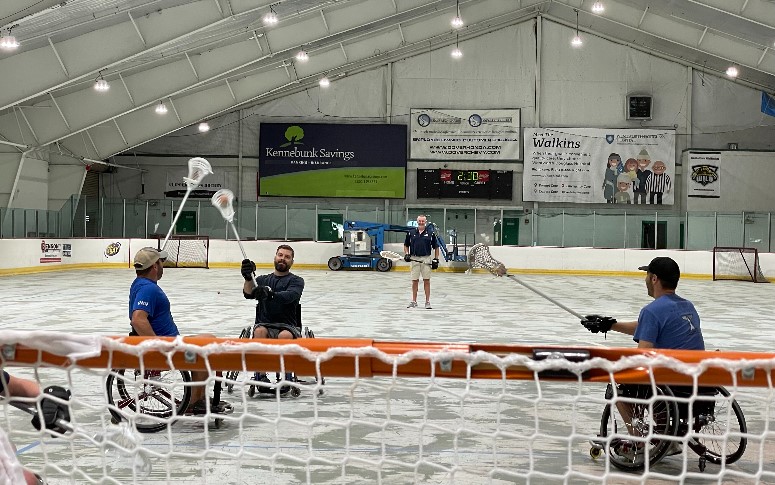

DOVER, N.H. -- In a New Hampshire ice hockey arena that was bereft of Ice, Wheelchair Lacrosse USA held its first official coach development clinic over the weekend. A mixture of local lacrosse coaches, physical therapists and lacrosse enthusiasts attended the two-day event.
The clinic was put together by USA Lacrosse regional manager Shawn Maloney. Maloney, who also plays for a Wheelchair Lacrosse team in Colorado, helps to run that same Wheelchair Lacrosse team in Denver.
His passion and ability to communicate were evident from the outset. Maloney has a calm and relaxed demeanor that allowed him to communicate with everyone in attendance. Whether he was teaching the proper technique for scooping the ball, chair skills or how to play defense, his instructions were clear and concise.
The first session focused primarily on disability awareness and the different adaptations that the game applies to and for the athletes. It’s important to know that wheelchair lacrosse is a modified and inclusive version of the game of lacrosse. It’s not an offshoot or a derivation; it’s lacrosse made more accessible to differently abled athletes.
Wheelchair lacrosse is a hybrid of the field and box versions of the game. Like box, it is typically played in ice hockey arenas or similarly designed enclosures and/or outside rinks. Each team has eight players (including the goalie).
Similar to field lacrosse, two attacking players (not three) must stay behind the half-line at all times. Three defensive players (including the goalie) must stay behind the half-line as well. In addition to those five players, there are three midfield players that can operate unrestricted on the playing surface.
The wheelchair that is used in Wheelchair Lacrosse is a modified chair. The wheels are differently cambered to provide more stability and maneuverability. In addition, a front cage protects the user’s feet. That cage is just slightly higher off the ground than the height of a lacrosse ball, so they can roll underneath.
This modified version of the game is played with a no-bounce lacrosse ball. Now, anyone that has practiced with a no-bounce lacrosse ball in the past remembers the heavy brown rocks, but new technology has been developed to make the balls that are used in Wheelchair lacrosse mimic the characteristics of field and box lacrosse balls in all aspects except the high bounce rate. That being said, it’s still a lacrosse ball, so if you get tagged with a shot it’s not going to feel great.
Players come to the game of Wheelchair lacrosse from a number of different avenues. It’s a modification of the great game of lacrosse that is inclusive. Nothing is lost in the translation, in fact, a new appreciation can be gained.
Personally, I had a great time learning how to translate my stand-up ability to this new version of the game. While operating the chair itself was difficult at first, the instruction provided by Maloney and the rest of the operations staff was second to none.
If you know anyone that wants to contribute to the organization as a coach or a player, please do not hesitate to contact the Wheelchair lacrosse organization on its website or contact USA Lacrosse.
@TheKyleDevitte
kyle.devitte@laxjournal.com